
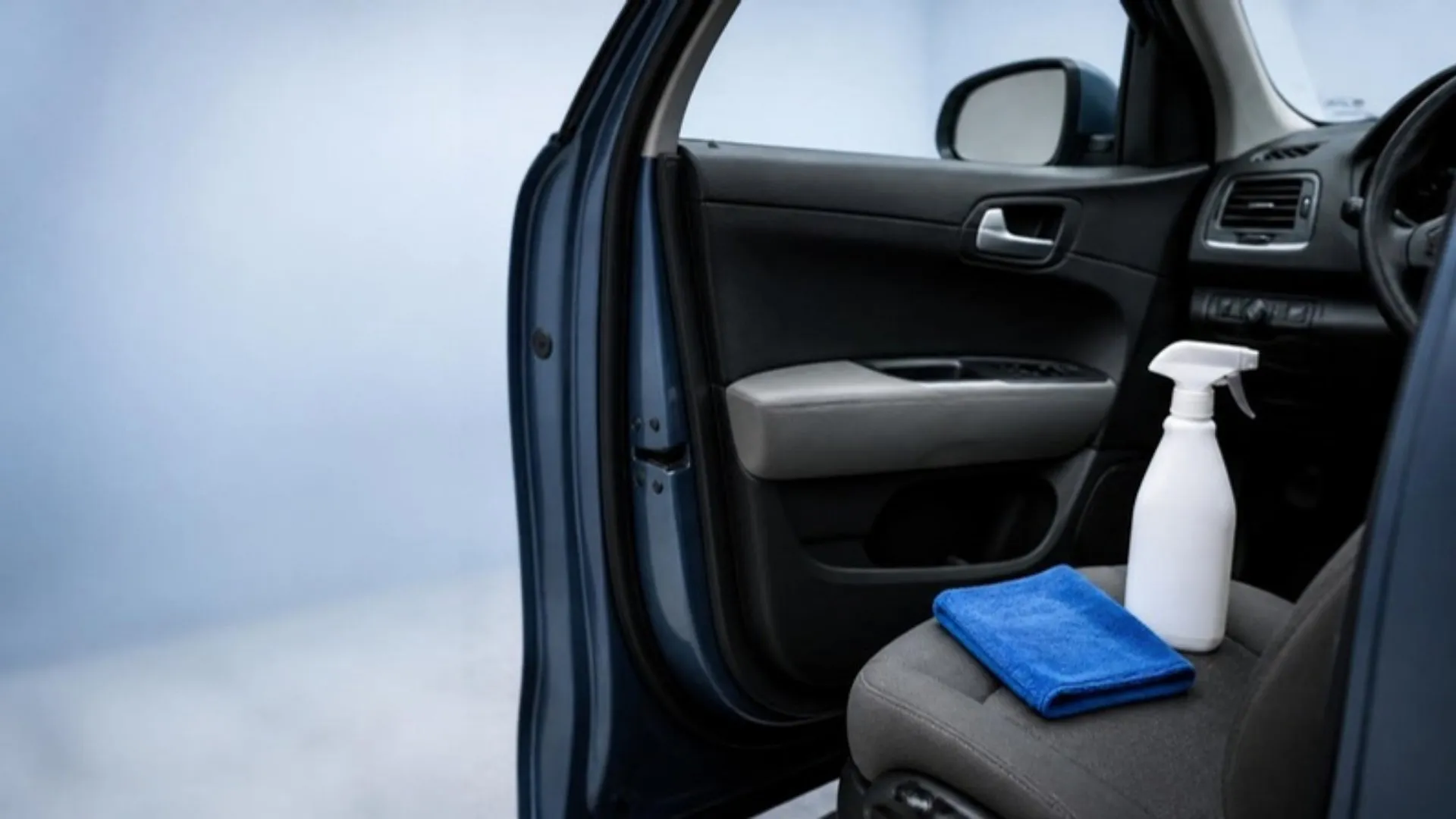
Can you use degreaser on car interior? In almost every case, no. A degreaser is built for greasy engines, machinery and shop floors, and it can really damage the plastics, vinyl, leather and fabric inside a car. For interiors, we would stick to a pH-neutral interior cleaner or a diluted all-purpose cleaner (APC).
Below is what is actually in a degreaser compared to an APC, the damage we see when degreaser goes on an interior, and what we use instead.
Why you shouldn’t use degreaser inside a car
For 99% of interiors, we would not recommend a degreaser. It is stronger than anything a dash or door panel needs, and the damage is easy to do and hard to undo.
The two problems we have seen on real cars:
- Chemical drip lines. Degreaser runs down a panel and leaves a line where it sat.
- Flash drying. The degreaser dries on the surface before you can wipe it off and leaves a mark behind. A hot car or a panel in the sun makes this happen faster.
Strong alkaline cleaners can also fade the dye in fabric and dull or discolor plastic and vinyl. We would save degreaser for the jobs it is made for, such as a greasy engine bay.
What’s in a degreaser vs an APC
There is no legal rule for what goes into a “degreaser” or an “all-purpose cleaner”, so the formula changes from brand to brand. The product’s safety data sheet (SDS) lists the main ingredients and usually the pH. These are the typical differences:
| Typical degreaser | Typical APC | |
|---|---|---|
| Built for | Oil and grease on engines, machinery and floors | General cleaning inside and out, adjusted by dilution |
| pH | Highly alkaline, often 11 to 14 | Alkaline or pH neutral, depending on the product |
| Common ingredients | Sodium hydroxide (lye), sodium metasilicate, butyl solvents such as 2-butoxyethanol | Detergents, sometimes a citrus solvent such as d-limonene |
| How strong you use it | Often strong, then rinsed off | Diluted to the job, weakest for interiors |
The pH scale is logarithmic. Each step up is 10 times more alkaline, so a pH 12 degreaser is 100 times more alkaline than a pH 10 cleaner. That high alkalinity, along with the solvents, is what breaks down grease so fast. It is also what attacks interior surfaces that were never meant to take it.
An APC is a different tool. You dilute it to the job: stronger for wheel wells and engine bays, much weaker for the interior. Some APC concentrates are as alkaline as a degreaser straight from the bottle, so the dilution is what makes them suitable inside the car. A pH-neutral interior cleaner is gentler again and made only for inside the car.
What to use instead
For most interior cleaning, we would suggest a pH-neutral interior cleaner. For dirtier spots, an APC diluted for interior surfaces does the job.
The APCs we recommend are:
- 3D All Purpose Cleaner. 3D lists it for leather, vinyl, plastic, rubber and fabric. It can be used straight or diluted.
- Gtechniq W5 Citrus All Purpose Cleaner. Gtechniq’s directions call for up to 10:1 on door panels, vinyl, floor mats and other interior surfaces, and full strength for heavy grime, brake dust and stubborn dirt.
- Meguiar’s D101 All Purpose Cleaner. Another common option. The label gives 10:1 for medium-strength cleaning and 4:1 for heavy-strength cleaning, and 10:1 is the usual mix for carpets, upholstery and vinyl.
If you don’t want to use a pH-neutral cleaner, a rinseless wash also works for light interior cleaning, such as dust and fingerprints on the dash and door panels. It is not as strong as a dedicated interior cleaner, so we would save it for light dirt. We cover how rinseless washes work in rinseless wash vs waterless wash.
It is worth checking the label for the interior dilution and starting with the weakest one that works. Our dilution ratio calculator works out how much concentrate and water to put in your bottle.
If you are cleaning leather, we cover that separately in can you use all purpose cleaner on leather seats. For the full list of products to start with, see mobile detailing chemicals.
How to avoid drip lines and flash drying
The same two problems can happen with a diluted APC, just with less damage. A few habits keep them away:
- Spray onto your towel or brush instead of straight onto the panel, so nothing runs.
- Work in the shade on a cool surface.
- Clean one small section at a time.
- Wipe the cleaner off before it has a chance to dry.
This is also why we suggest a pH-neutral cleaner for beginners. It gives you more room for error when the car is sitting in the heat.
Safety: read the label and SDS before you use any cleaner, wear gloves when you mix concentrates, and never mix two chemicals together.
Overall
Overall, can you use degreaser on car interior? In almost every case, no. A degreaser is built for greasy engines, machinery and shop floors, and on an interior it can leave drip lines and flash-dried marks. We would suggest a pH-neutral interior cleaner for most interior cleaning and an APC diluted for interior surfaces for dirtier spots, starting with the weakest dilution that works.