
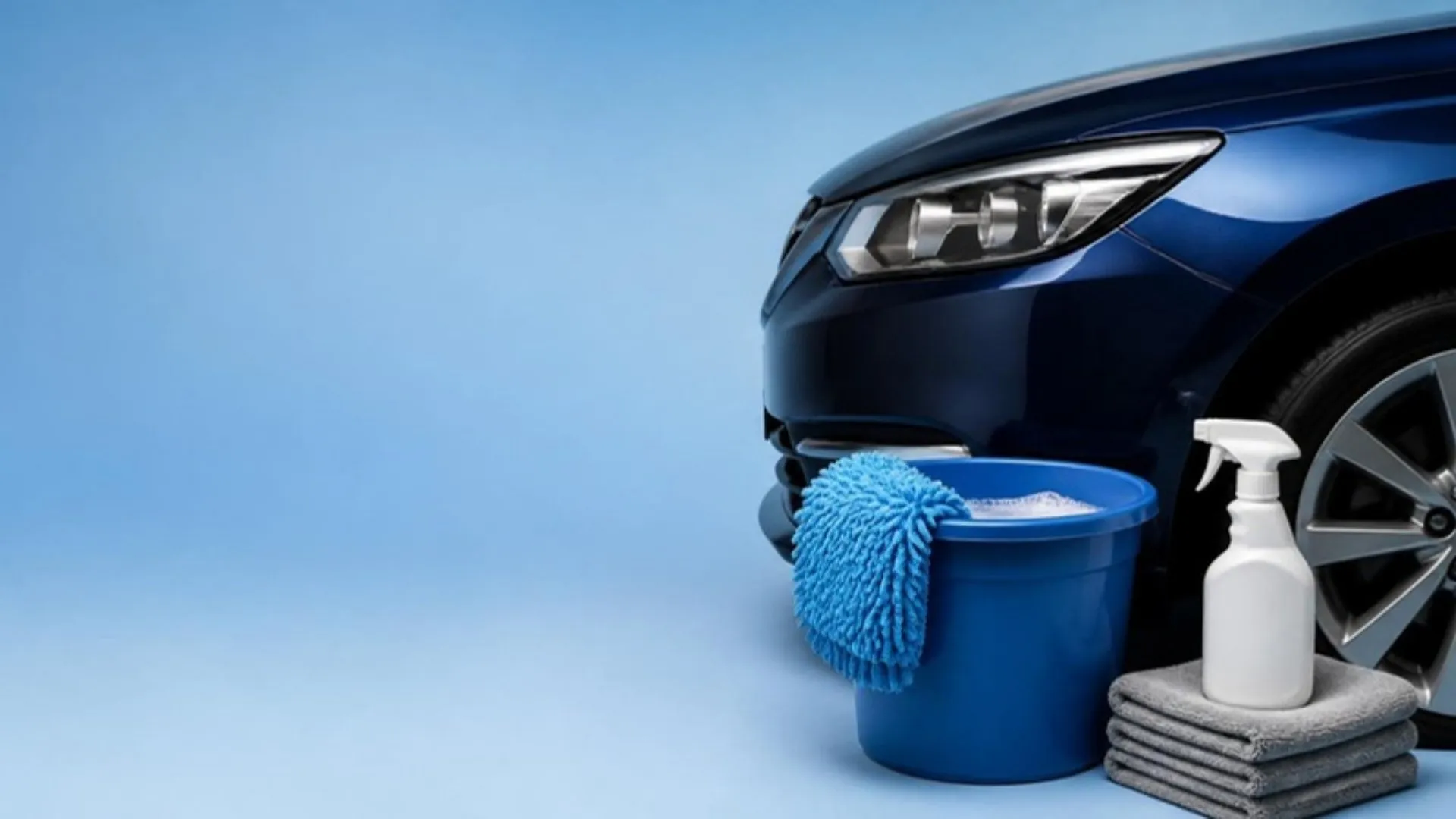
The difference between a rinseless wash and a waterless wash is water. A rinseless wash uses a small amount of water mixed with a rinseless product in a bucket, and you never rinse the car with a hose. A waterless wash uses no water at all, just the product in a spray bottle and a lot of towels.
Both let you wash a car where a hose or pressure washer isn’t an option. Below is how each one works, how they compare and when to use which.
How a rinseless wash works
A rinseless wash is a process that uses far less water than a normal wash. You mix the product into a bucket of water, wash the car one panel at a time with a mitt or towels soaked in that solution, and dry each panel as you go. There is no rinse at the end.
The product encapsulates the dirt. The polymers and lubricants in it lift dirt off the paint and hold it in the solution so it can be wiped away instead of dragged across the surface.
How much water it takes depends on the product and the car. As an example of label directions, Optimum No Rinse calls for 1 oz in 2 gallons of water and says that is enough for a whole car. We go through real water use per car in how much water does a mobile detail use.
A rinseless wash handles more dirt than a waterless wash, but it has limits. Even Optimum notes that a heavily soiled car may need a pre-rinse first.
How a waterless wash works
A waterless wash uses no water at all. It is just the chemical and a lot of rags. You spray the product heavily onto a panel, wipe the dirt off with a clean microfiber towel and buff it dry with another.
The towels are what make it work. Once a side of the towel is dirty, flip to a clean side, and once every side is used, switch to a new towel. If you keep using a dirty towel, you drag dirt from one panel to the next.
Because nothing rinses or soaks the dirt first, a waterless wash suits light dust, fingerprints and a car that is already fairly clean.
Rinseless vs waterless at a glance
| Rinseless wash | Waterless wash | |
|---|---|---|
| Water | A few gallons in a bucket | None |
| What you need | Bucket, rinseless product, wash mitt or towels, drying towels | Spray bottle of product, lots of microfiber towels |
| How the dirt comes off | Product encapsulates the dirt in the solution, then you wipe and dry | Product lubricates the dirt, then you wipe it into the towel |
| Best for | Light to moderate dirt | Light dust and fingerprints |
| Dilution | Depends on the product | Depends on the product, often ready to use |
How to dilute rinseless and waterless washes
The dilution really depends on the product, so it is worth following the label. Some rinseless products also list a stronger mix for other jobs, such as clay lube or a quick detailer, and some brands sell one concentrate that works as both a rinseless and a waterless wash at different strengths.
We would only use a rinseless product as a waterless wash if the label says you can. Many brands make the two as separate formulas, because a rinseless wash mixed at bucket strength doesn’t have enough in it to do the job of a waterless spray.
Our dilution ratio calculator works out the ounces of concentrate for whatever bottle or bucket you are filling. Some detailers also mix their rinseless wash into a window cleaner. We cover that and the other products to start with in mobile detailing chemicals.
Can you use rinseless wash on the interior?
Yes. A rinseless wash can be used on the interior for light cleaning, such as dust and fingerprints on the dash, door panels and other hard surfaces. It is a good option if you don’t want to use a pH-neutral interior cleaner.
It is not as strong as a dedicated interior cleaner or a diluted APC, so we would keep it for light dirt. It is worth checking the label for an interior dilution and testing a small hidden spot first. For heavier grime inside the car, see can you use degreaser on car interior, which covers what to use instead.
Which one to use on a mobile detailing job
We would use a rinseless wash when the car has real road dirt on it and you can carry a few gallons of water, and a waterless wash for light dust, a quick touch-up or when you have no water at all.
For a mobile business, rinseless is the bigger deal. It cuts the water you carry, and water is heavy at 8.34 lb a gallon, which matters when you are sizing a tank. We go through tank size and vehicle payload in our mobile detailing equipment list.
It is also one of the cheapest ways to start. You can begin with a rinseless wash and add a pressure washer and the rest of the gear as the money comes in. We break down what that costs in how much does it cost to start a mobile detailing business.
Overall
Overall, the difference between a rinseless wash and a waterless wash is water. A rinseless wash uses a few gallons of diluted product in a bucket and no hose, and it handles light to moderate dirt. A waterless wash uses no water, just the spray and plenty of clean towels, and suits light dust and fingerprints. For a mobile detailing business, rinseless is the bigger deal because it cuts the water you carry. Either way, it is worth following the label for the dilution.