
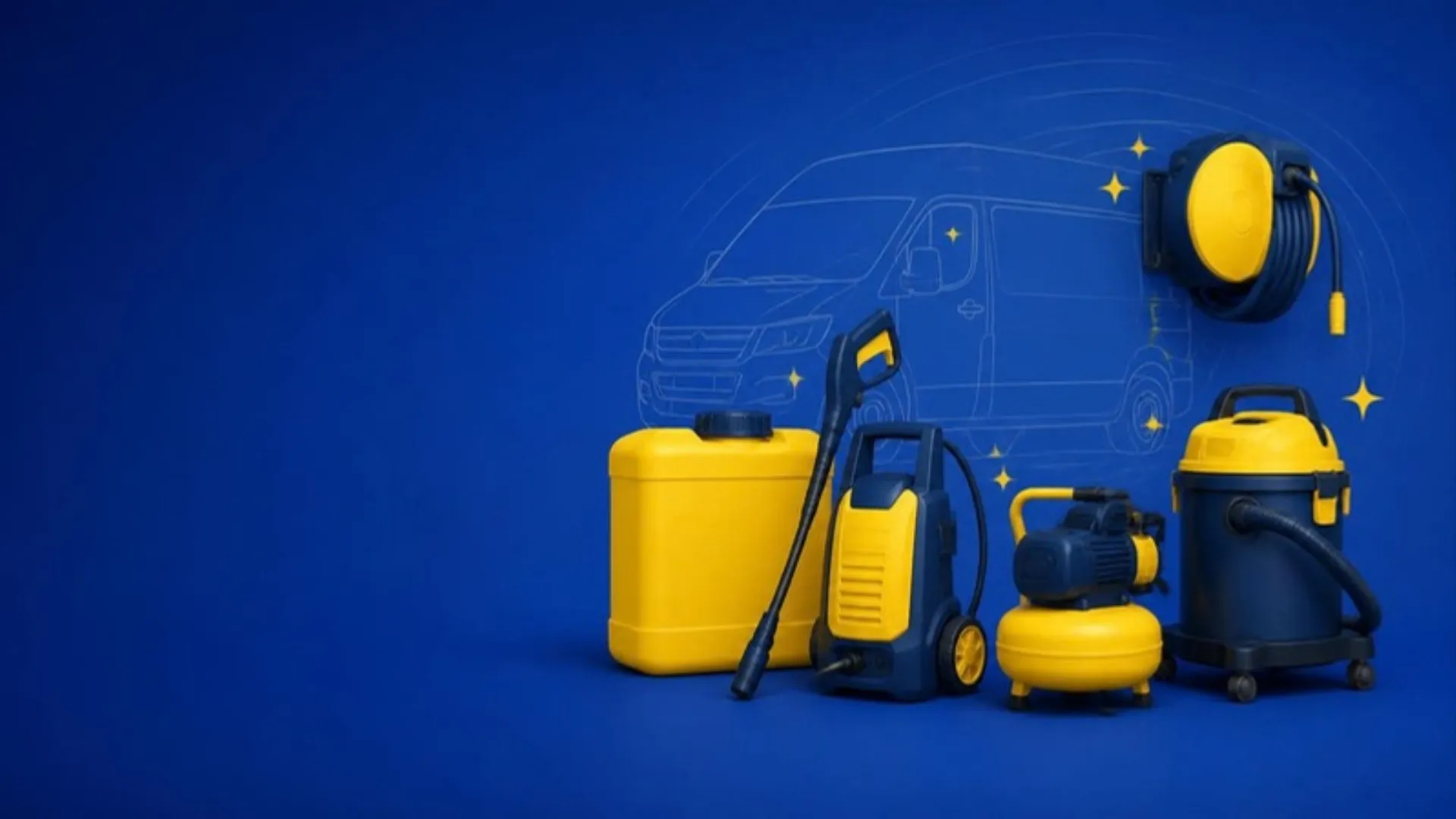
A mobile detailing equipment list for a truck or van comes down to six things: a water tank, a generator, a pressure washer, an air compressor, a vacuum and hose reels. With those you can do a full wash and interior without hooking up to anything at the customer’s place.
This list is the core setup for full-service mobile detailing. Polishers, extractors, steamers and chemicals sit on top of it and depend on the services you sell. We cover polishers in DA polisher vs rotary polisher and chemicals in mobile detailing chemicals.
Water tank
The water tank is the one item you can’t skip. Without your own water you depend on the customer having a usable outdoor tap, and many don’t.
We would size it to the work you do in a day, then check it against your vehicle’s weight limit. Water weighs 8.34 lb per gallon, so the tank gets heavy quickly:
| Tank size | Water weight (full) |
|---|---|
| 50 gallons | about 417 lb |
| 100 gallons | about 834 lb |
| 150 gallons | about 1,251 lb |
That weight comes out of your payload along with the generator, fuel, compressor, vacuum and chemicals. The payload figure is on the sticker in the driver door jamb. It is worth adding it all up before you pick a tank size.
To work out how much water you need, take your pressure washer’s flow rate in gallons per minute and multiply by the minutes it runs per car. As an example only: a washer using 2 GPM for 15 minutes of running time uses 30 gallons per car. Your numbers will differ, so it is worth measuring your own.
Generator
The generator runs the pressure washer, the compressor and the vacuum. We would pick it by adding up the running watts of everything you will run at the same time. Electric motors also pull extra power for a moment when they start, so it helps to check the starting watts on each tool’s label.
Our guide to choosing the best generator for mobile detailing goes through the watt math step by step and compares the generators we would look at.
Here is an example of how the math works. These are example figures, not specs for any product:
| Tool | Example running watts |
|---|---|
| Electric pressure washer | 1,500 |
| Vacuum | 1,200 |
| Air compressor | 1,000 |
Running all three at once would be about 3,700 running watts, with more needed at startup. If you only run one at a time, the generator can be smaller. It is worth reading the labels on your own tools and doing the same sum.
Inverter generators are quieter than open-frame ones, which matters when you are working in someone’s driveway or at their workplace.
Safety: a generator puts out carbon monoxide. Never run it inside the van or in an enclosed space, and keep the exhaust away from open windows and doors. Keep a carbon monoxide alarm in the vehicle. Store fuel in approved containers outside the cab, and let the engine cool before refueling.
Pressure washer
You need a pressure washer to rinse, to apply foam and to clean wheel wells and tires. Electric and gas models both work. Electric is quieter and usually uses less water. Gas has more flow and doesn’t use generator capacity.
We would match it to your water tank and your power. A higher flow rate empties the tank faster, and an electric washer is a big load on the generator. Keep the water spray away from people and pets, and never point it at your own hands or feet.
Air compressor
The compressor handles tire inflation and blowing water and dust out of vents, seams and tight spots, and it can run air tools. It is worth checking the CFM rating your tools need and buying a compressor that meets it.
A compressor motor draws extra power each time it starts, so we would count it in your generator math.
Vacuum
A wet/dry shop vacuum is the usual choice for the interior. Corded vacuums run off the generator. If you go cordless, it helps to check how long the battery lasts and whether you can swap in a spare, because you can’t plug in at the customer’s place.
Hose reels
Hose reels aren’t strictly required, but we recommend them. They keep the water hose, the pressure washer hose and the air hose off the ground, where they pick up dirt and get stepped on, and they stop kinks and tangles at setup and pack-up.
It is worth checking that the reel is rated for the pressure of the hose it holds, especially a pressure washer hose. We would mount them where you can reach them from the back or side of the vehicle without moving other gear.
Printable equipment checklist
This is the same mobile detailing equipment list in a form you can print or save as a PDF.
Core setup
- Water tank, sized for a day’s work, with the full weight inside your vehicle’s payload
- Generator with enough running watts for the tools you run together, plus their starting watts
- Pressure washer, electric or gas, with a flow rate that suits the tank
- Air compressor with a CFM rating that meets your tools
- Wet/dry vacuum, corded or cordless with a spare battery
- Hose reels for the water, pressure washer and air hoses, each rated for its hose’s pressure
Safety
- Carbon monoxide alarm in the vehicle
- Approved fuel containers, stored outside the cab
Added for the services you sell
- Polisher
- Extractor
- Steamer
- Chemicals
Overall
Overall, the mobile detailing equipment list we would start with is a water tank, a generator, a pressure washer, an air compressor, a vacuum and hose reels. The water tank is the one item you can’t skip, and it is worth checking its full weight against your vehicle’s payload. We would size the generator by adding up the watts of the tools you run at the same time. Hose reels aren’t strictly required, but we recommend them. Polishers, extractors, steamers and chemicals come on top, depending on the services you sell.