
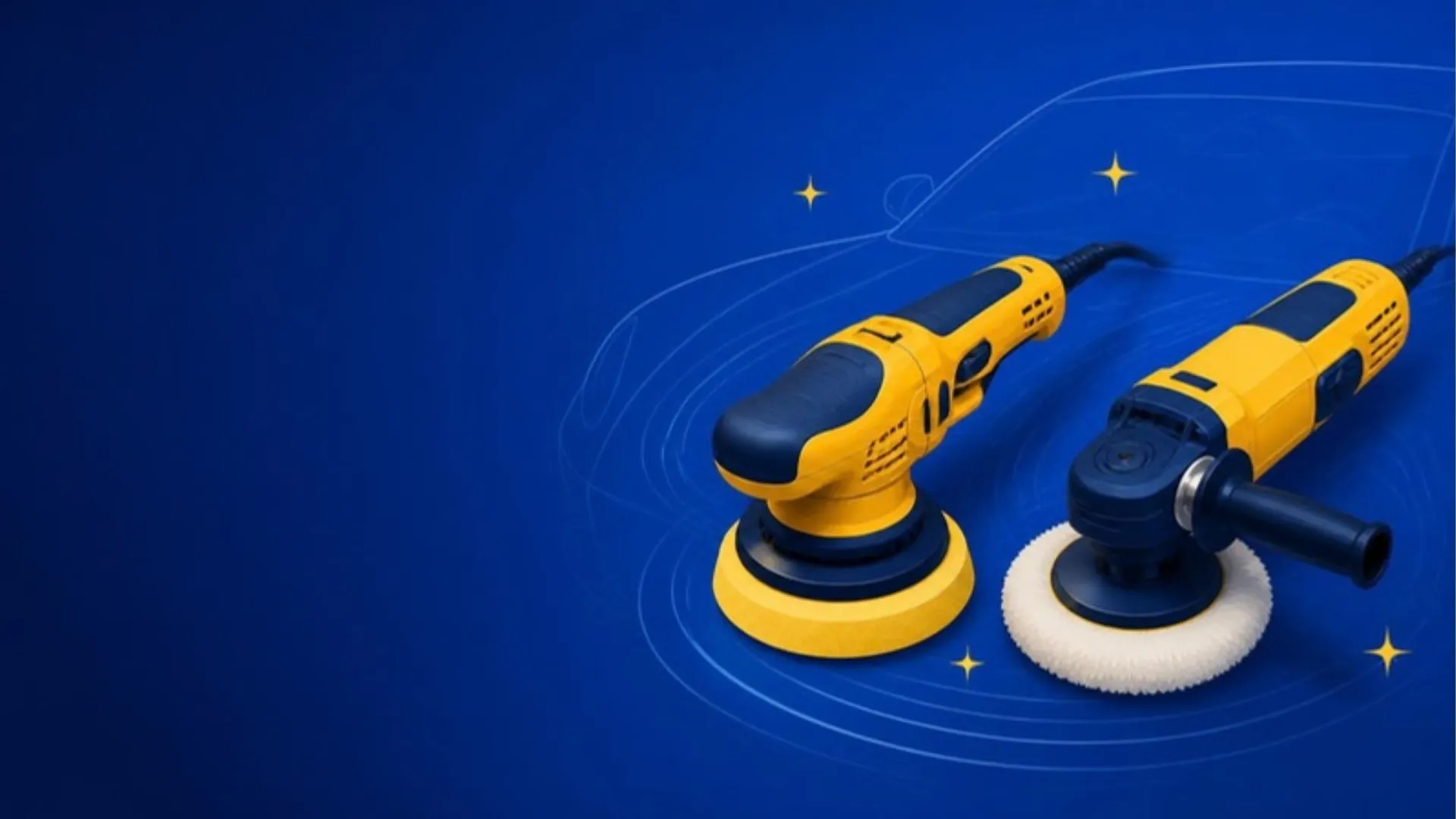
The difference between a DA polisher vs rotary polisher is how the pad moves. A dual action (DA) polisher spins the pad and also shakes it side to side. That makes less heat and cuts less paint. A rotary polisher only spins. It cuts more, but it gets much hotter.
So which one should you use in your detailing business? Eventually, we would suggest both. You can get away with just a DA if you only do paint enhancements. For deeper corrections, we would recommend a rotary, if you have a lot of experience and want to get deeper imperfections out quicker. If you are new, we would start with a DA.
What is a DA polisher?
A DA polisher is a dual action polisher. Some people call it a random orbital polisher. The pad spins, and it also moves side to side at the same time. This spreads the heat out, so it does not build up in one spot.
Less heat means the machine takes off less paint. It is much harder to burn through the clear coat. The downside is that a DA cuts less than a rotary.
A DA also slows down if you push too hard. The pad can stop spinning. That keeps you safe, and it tells you to ease up.
The side-to-side movement is called the throw. Most DAs have a throw between 8mm and 21mm. A bigger throw cuts more. A smaller throw is easier to use on curved panels.
What is a rotary polisher?
A rotary polisher spins the pad in one circle, like a drill. The heat has nowhere to go, so it builds fast. If you use it wrong, it can burn through the clear coat very quickly. A rotary can also leave rotary trails and haze in the paint.
The good part is the power. A rotary always cuts more than a DA. That is why it is the tool for badly damaged paint.
DA polisher vs rotary polisher: the differences at a glance
| DA polisher | Rotary polisher | |
|---|---|---|
| How the pad moves | Spins and shakes side to side | Spins in one circle |
| Speed rating | Orbits per minute (OPM) | Revolutions per minute (rpm) |
| Heat | Low | High |
| Cutting power | Lower | Higher |
| Finish | Finishes well and is easy to get right | Can finish very well, but can leave trails and haze |
| Learning | Easier | Harder |
| Risk to clear coat | Low | High if used wrong |
| Tight areas | Harder to use | Easier to use |
| Best job | Making paint look better, and finishing | Deep damage and very bad paint |
When a DA polisher is the better choice
- It is easier to learn. You get good results sooner, with less practice.
- It is lower risk. Less heat means a mistake is much less likely to cost you clear coat.
- It is great for paint enhancement. For more shine and light swirls, a DA does the job.
- It applies wax and sealant. A DA is the usual machine for spreading them.
When a rotary polisher is the better choice
- Deeper damage. When the paint is badly damaged, a rotary fixes it faster than a DA.
- More cut. A rotary always cuts more, so you need fewer passes on the worst panels.
- Tight areas. A DA is harder to use in tight spots. A rotary handles them more easily.
All three come with the same warning. A rotary makes a lot of heat, and clear coat is thin. Once it is gone, you cannot put it back.
Does paint hardness change which polisher you need?
Yes. Hard paint is harder to cut, so a rotary helps more there. Soft paint cuts easily, so a DA is usually enough.
Hard paint is common on RVs, boats, anything with lacquer paint, and some older cars. Many people also say German cars have hard paint. Luxury cars in general usually have thicker paint. Japanese cars, like a Nissan, usually have softer paint.
Not sure what you have? It is worth testing a small spot first, starting with the gentlest pad and polish.
Can a DA polisher remove scratches and swirls?
A DA can remove swirls and light to medium scratches. On deeper damage, it takes more passes. A rotary still cuts the most.
If a DA is not getting it done, do not keep pushing on the same spot. You can move up to a rotary if you have the skill, or accept a lighter result.
Which pads should you use?
We would pick the pad for the job, not for the machine. You can use any mix of pads. It depends on how much damage you are removing, or whether you are finishing.
One exception: wool pads. They are usually used with a rotary, for heavy cutting. You see them most on RVs and boats.
Why many detailers use both
In the DA polisher vs rotary polisher question, many detailers use both. They cut with a rotary first, then finish with a DA. The rotary does the heavy work. The DA cleans up the trails and haze a rotary can leave.
This is common, but it is not a rule. A rotary can finish very well, and so can a DA. We would finish with the machine you are best with.
In a detailing business, we would suggest eventually using both. You can get away with just a DA if you only do paint enhancements. For deeper corrections, we would recommend a rotary, if you have a lot of experience and want to get deeper imperfections out quicker.
What about a forced rotation DA?
A forced rotation DA sits between the two. The pad is pushed to spin as well as shake, so it does not stall as easily. It cuts harder than a regular DA. It still runs cooler than a rotary.
It is good to know it exists. But choosing between a DA and a rotary is the first decision.
Can you polish a ceramic coated car?
We would not, unless it is a very light polish with a finishing pad. Polishing can wear down the coating. If the paint needs real correction, expect to redo the coating afterward.
Is a rotary better than a DA, or a DA better than a rotary?
Neither is better for everything. Each one is made for a different job.
A rotary cuts more. A DA is easier and safer to use. For most jobs, we would suggest a DA. Most jobs only need paint enhancement, and a mistake with a rotary costs a lot. That is the short answer to the DA polisher vs rotary polisher question.
Should I get a DA or a rotary polisher?
We would suggest a DA first. It is easier to learn, it is safer, and it handles most paint enhancement.
When you are just starting out, almost any DA polisher will do. A Harbor Freight DA is a good place to start. It costs less than a name-brand machine, and you can learn on it.
You can add a rotary later if you keep running into paint a DA cannot fix, and you have the practice to control one. We would not buy a rotary as a first machine just to cut faster. It is worth practicing on a junk panel before you use a new machine on a customer’s car.
How long does paint correction take?
It depends on your skill level. A beginner will take much longer than someone who has done it many times. It is worth taking your time, and not rushing the first panel.
Measure the clear coat before you polish
The most common mistake we see is polishing paint without measuring the clear coat first. This happens with both DA and rotary polishers. Every pass takes off clear coat that you cannot put back. A paint thickness gauge tells you how much you have before you start.
It is worth measuring each panel you plan to polish. Paint is not the same thickness all over a car. If a panel reads thin, we would go gentler, or leave it alone.
Staying safe with a DA or rotary polisher
- Keep the pad moving. Even a DA can burn the clear coat if you hold it in one spot.
- Be careful on edges and body lines. The paint is thinner there, and heat builds fast.
- Test a small spot before you do a whole panel.
- A scratch that goes through the clear coat cannot be polished out. Stop and leave it.
Overall
Overall, in the DA polisher vs rotary polisher question, we would suggest a detailing business eventually uses both. You can get away with just a DA if you only do paint enhancements. It is easier to learn, it runs cooler, and it handles most paint enhancement. For deeper corrections, we would recommend a rotary, if you have a lot of experience and want to get deeper imperfections out quicker. Whichever machine you use, it is worth measuring the paint and testing a small spot before you start.