
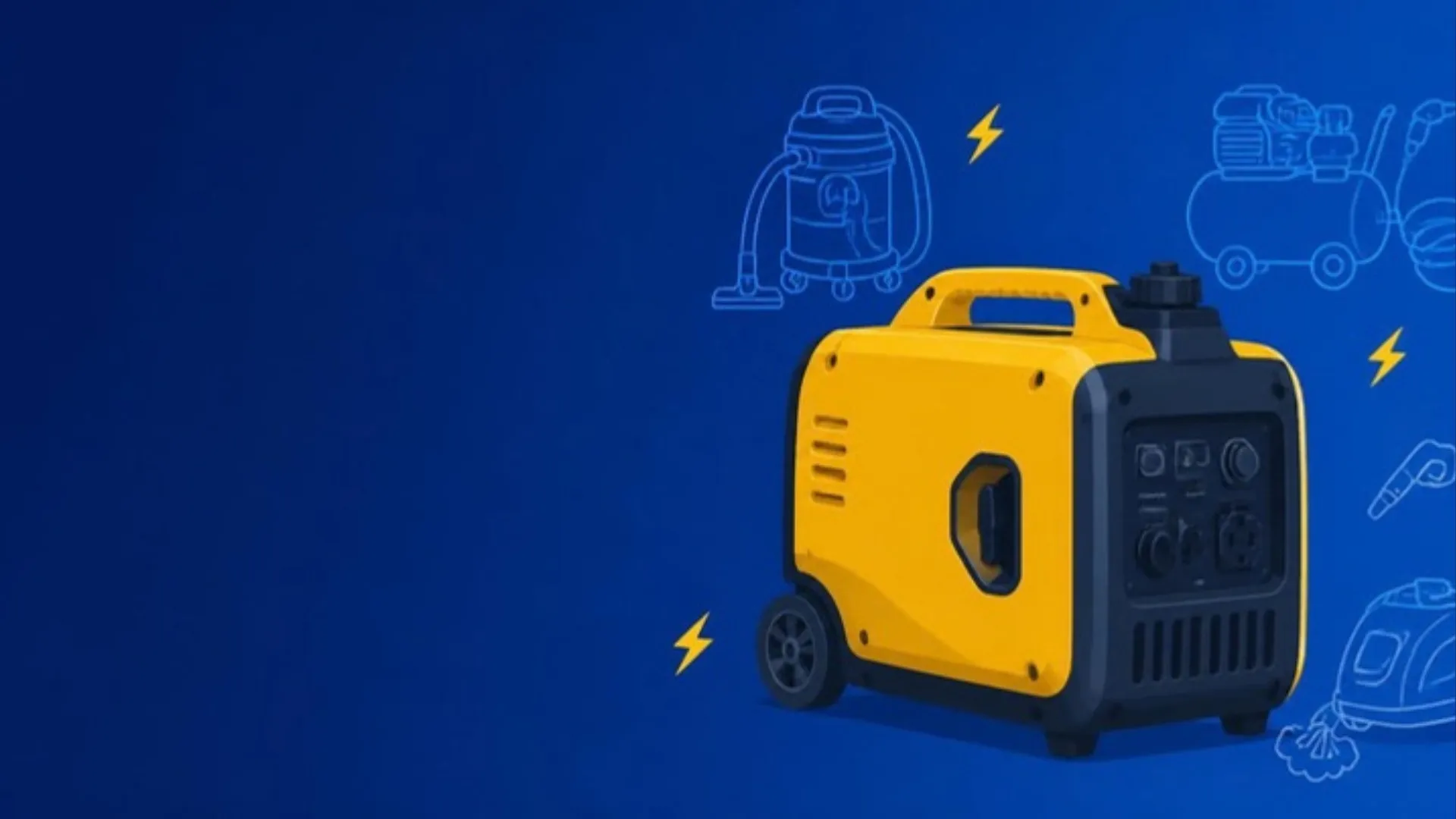
The best generator for mobile detailing under $1,000 is a 5,000-watt model. It is the smallest size we would trust to run a vacuum, an air compressor and a steamer on the same job. With a 5,000-watt generator, we have run two vacuums and an air compressor at once and it did not stall.
That is better than the label math suggests. Add up the labels on the example tools further down and two vacuums and a compressor come to 4,400 running watts, which is over the rating of most 5,000-watt generators. Label numbers are the worst case: real draw is often lower, and a compressor only pulls its startup surge for a moment. So we would treat 5,000 watts as the floor, not as room to spare, and it is worth doing the math on your own tools before you buy.
Our pick for the best generator for mobile detailing on a budget is the Harbor Freight Predator 5000 dual-fuel inverter, rated at 5,000 peak watts. We do not recommend open-frame generators for mobile detailing because they are way too loud. The open-frame Predator 5000 and the Champion 5000 are in this guide so you can compare price, running watts and warranty, but both are open frame. In our experience of daily detailing, generators below 3,500 watts tend to go out within a year. Our 3,500-watt and 5,000-watt generators have lasted several years, and the 5,000-watt units have been the most reliable.
This guide covers how to choose the best generator for mobile detailing work: the watt math for your own equipment, how the generators compare, what the warranties actually cover, what fuel costs you per detail, and how to keep one running.
Why the best generator for mobile detailing starts at 5,000 watts
A vacuum, an air compressor and a steamer all pull a lot of power, and a mobile detailer often runs them at the same time. We would call 5,000 peak watts the bare minimum.
The reason is the air compressor. Its motor pulls much more than its running watts for a moment when it starts, and a small generator has no room left for that on top of a vacuum. A generator in the 2,000-watt range is working very hard with this equipment. Pushing a small engine near its limit strains it, trips the overload protection, makes it run hot and wears it out faster.
How long a generator lasts in daily detailing
The best generator for mobile detailing is the one still running in year three, so lifespan counts as much as watts. This is our experience from daily detailing, not a lab test. Generators below 3,500 watts tend to go out within a year. Our 3,500-watt and 5,000-watt generators last several years, and the 5,000-watt generators have been the most reliable of the group.
We put the difference down to strain. A smaller motor running near its limit all day is working a lot harder than a bigger one running the same tools. A small generator that has to be replaced every year costs more over several years than one bigger unit that lasts, so buying small to save money tends to backfire.
Care matters too. Later in this guide we cover oil, fuel and storage, which is where a generator’s life is won or lost.
Size and space in a truck or van
Space in a mobile rig is tight. A mobile detailing generator has to share the bed or the van with vacuums, a compressor, tanks, chemicals and tools, so a bigger generator is not automatically better. The 3,500 to 5,000-watt range is usually the right size: enough power for detailing equipment without taking up too much room.
The generators in this guide run from about 102 to 152 pounds and from roughly 23 to 30 inches long. It is worth measuring the spot you plan to put it in before you buy, keeping in mind that the exhaust needs to point away from the vehicle and the work area.
The Predator is the generator we see most often in mobile detailing rigs. That is what we notice in the field, not a survey.
How to do the watt math for your equipment
Sizing is most of the job of picking the best generator for mobile detailing, and it comes down to two numbers per tool. Every motor has two numbers: running watts, and the higher starting (surge) watts it pulls for a moment when it kicks on. Air compressors have the biggest surge of anything in a detailing setup.
- Find the label or data plate on each tool. If it lists amps, multiply by 120 volts to get watts.
- Add up the running watts of everything that will run at the same time.
- Add the extra startup surge of your biggest motor, usually the compressor. That is its starting watts minus its running watts.
- Compare the running total to the generator’s running watts, and the surge total to its starting watts. Stay under both.
Compressors often do not list starting watts. If the data plate shows locked rotor amps (LRA), multiplying that by 120 volts gives a good estimate of the startup draw.
These are example numbers, not our equipment. You can swap in your own labels.
- Shop vacuum: a RIDGID 12-gallon NXT is listed at 9 amps, which works out to about 1,080 watts. A 12-gallon Shop-Vac label reads 11.6 amps, about 1,400 watts.
- Small air compressor, 1 HP class: about 1,600 running watts and 4,500 starting watts.
- Car steamer: about 1,500 watts. Car steamers are commonly listed at 1,500 to 2,000 watts.
Here is the math for two 1,400-watt vacuums and that compressor. Running watts are 1,400 + 1,400 + 1,600 = 4,400. The compressor’s surge above its running watts is 4,500 minus 1,600, which is 2,900. Add that to the running total and the peak at compressor startup is 7,300 watts.
| Example load running together | Running watts | Watts at compressor start |
|---|---|---|
| One vacuum and the compressor | 3,000 | 5,900 |
| Two vacuums and the compressor | 4,400 | 7,300 |
| Two vacuums, compressor and steamer | 5,900 | 8,800 |
| One vacuum and the steamer | 2,900 | 2,900 |
Label numbers are the worst case. Real draw is often lower, and a compressor only pulls its startup surge for a moment. That is why a 5,000-watt generator handled two vacuums and a compressor on our jobs even though the label math is tight. We would not count on that for your setup. It is worth reading your own labels first.
How much of each generator the example loads use
Here is how the running watts from the table above stack up against each generator’s running rating. Anything over 100% is more than the generator is rated to run continuously.
| Generator (running watts) | One vacuum and compressor (3,000 W) | Two vacuums and compressor (4,400 W) | One vacuum and steamer (2,900 W) |
|---|---|---|---|
| Ryobi 2,200-watt inverter (1,700) | 176% | 259% | 171% |
| Predator 3500 inverter (3,000) | 100% | 147% | 97% |
| Predator 5000 inverter (3,900) | 77% | 113% | 74% |
| Predator 5000 open frame (4,000) | 75% | 110% | 73% |
| Champion 5000 open frame (5,000) | 60% | 88% | 58% |
Two things stand out. Nothing under 3,500 watts is close, which matches what we see in the field. And on label numbers, only the Champion stays under its running rating with two vacuums and a compressor. Add the steamer to that load and the example total reaches 5,900 watts, which is more than any generator in this guide is rated to run.
If your own label math lands over 100%, we would measure instead of guessing. The Predator 5000 inverter has a digital display that shows output power, so you can read your real load. The open-frame Predator and the Champion display volts, frequency and run hours, not watts.
The best generator for mobile detailing under $1,000, compared
These are the four we would put on the list, with the Ryobi left out because it is too small for compressor work.
| Generator | Running / starting watts | Price | Noise | Weight | Warranty |
|---|---|---|---|---|---|
| Harbor Freight Predator 5000 dual-fuel inverter (item 71367) | 3,900 / 5,000 on gas | $979.99 | 61.7 dBA | 110 lb | 90 days, 2 years on emissions |
| Harbor Freight Predator 5000 open frame (item 72613) | 4,000 / 5,000 | $499.99 | 71.3 dBA at 50% load | 110 lb | 90 days, 2 years on emissions |
| Champion 5000 open frame (100812) | 5,000 / 6,250 | About $400 to $950, depends on seller | 74 dBA at 23 ft | 152.1 lb | 3 years residential, 270 days commercial |
| Harbor Freight Predator 3500 inverter (item 71358) | 3,000 / 3,500 | $799.99 | 56 dBA | 102 lb | 90 days, 2 years on emissions |
Prices were checked on October 6, 2026 and they move, especially on sale. Makers test noise differently, so the decibel numbers are only a rough guide.
Harbor Freight Predator 5000: our pick for value
Our pick for the best generator for mobile detailing on a budget under $1,000 is the Predator 5000 dual-fuel inverter. We have used Harbor Freight Predator generators, and with proper care they give great results for a gas generator. This pick rests on that, on the specs, and on buyer reviews. Harbor Freight’s own listing shows 4.8 stars from 2,293 reviews for the inverter and 4.4 stars from 66 reviews for the open-frame model.
On label numbers the inverter is the tightest of the 5,000-watt generators here, with 3,900 running watts. We still pick it because it is the quietest of them, it burns the least fuel in our estimate, and its display shows output power, so you can read your real load instead of guessing. If your own label math lands well over 3,900 running watts, the Champion has more room on paper, but it is an open frame, and we do not recommend open-frame generators for mobile detailing because they are way too loud.
There are two versions of the Predator 5000:
- Dual-fuel inverter, $979.99. Our pick. 3,900 running watts, a 61.7 dBA rating, electric and remote start, and wheels and a telescoping handle in the box. Harbor Freight lists 18.2 hours on its 3.7-gallon tank at 25% load.
- Open frame, $499.99. Cheaper, but not one we recommend. The cheaper way into 5,000 watts, with 4,000 running watts and a 5.41-gallon tank for 15.2 hours at 50% load. It is a lot louder, and the wheel kit is sold separately.
California buyers: the 49-state inverter is not sold in California. The California-compliant 5,000-watt dual-fuel inverter was $1,199.99 when we checked, which is over this guide’s budget. The open-frame Predator offers a California-compliant option at checkout.
Next to a Honda, the price gap is large. Harbor Freight’s own comparison chart lists the Honda EU3000iS at $2,399 with 2,800 running watts, against 3,900 on the Predator inverter. That is Harbor Freight’s chart, not ours.
Warranty: what Harbor Freight and Champion cover
Warranty is part of choosing the best generator for mobile detailing, because a machine that works every day will eventually need one. Harbor Freight guarantees a Predator generator against defects in materials and workmanship for 90 days from purchase. The emissions system is covered for two years if the engine has been maintained properly.
Harbor Freight also sells Extended Service Protection, which adds one or two years. It is bought separately, starts when the manufacturer’s warranty ends, and replaces the product if it fails. We have not priced it, so it is worth adding its cost to the Predator before you compare.
Champion backs its generators with a 3-year limited warranty for residential use and free lifetime technical support. For commercial and industrial use, Champion’s warranty page gives 270 days. It does not define commercial use, so if the generator is earning money on detailing jobs, we would plan on the 270 days and ask Champion to confirm. We could not find whether Harbor Freight’s 90 days changes for commercial use, so that is worth asking about too.
Either way, Champion’s warranty is the longer one. If warranty is the deciding factor, Champion is the stronger one on paper.
Champion 5000: more running watts and a longer warranty
Champion is the other name that comes up for the best generator for mobile detailing under $1,000. We have put hundreds of hours on Champion generators. The 100812 we compare here rests on its specs and on Champion’s record with us. It has a higher running rating than the open-frame Predator: 5,000 running watts against 4,000.
It runs up to 9 hours at 50% load on a 5.7-gallon tank, starts on a recoil pull, comes with a wheel kit, and is CARB compliant. It is also the heaviest generator in this guide at 152.1 pounds, which matters in a tight rig.
Champion prices swing widely by seller. We found Champion 5000-watt listings from $399.91 on sale to $954.49 at another seller. We have found Champion generators cheaper than the Predator, but it is worth checking the day you buy.
If your running load lands above about 3,500 watts, the Champion’s extra running watts give you more room than the Predator. It is an open frame, though, and at 74 dBA it is the loudest generator in this guide, which is why it is not our recommendation for mobile work.
Why we skip generators below 3,500 watts for compressor work
The Ryobi 2,200-watt inverter we have used is rated 1,700 running and 2,200 starting watts. One 1,400-watt vacuum leaves about 300 watts of room. A compressor’s startup draw alone, 4,500 watts in our example, is double the Ryobi’s peak.
A 3,500-watt inverter can get you by with an air compressor, but we would not rely on it. It is too small, and running it that close to its limit puts a lot of strain on a smaller motor. The Predator 3500 inverter is rated 3,000 running and 3,500 starting watts.
The price gap is also small. The Predator 3500 inverter was $799.99 and the 5000 inverter was $979.99, which is $180 for more running watts and remote start.
Inverter or open frame: noise at the job
Noise is the thing most people underrate when they pick a mobile detailing generator. We recommend an inverter for mobile detailing, and we do not recommend open-frame generators at all, because they are way too loud. You are often parked in front of an office building or in a residential area, and open-frame generators are typically a lot louder. A loud generator is bad for your ears and bad for the customer. If you run it for hours during a detail, they are less likely to call you back.
By the ratings, the Predator inverter is 61.7 dBA and the open-frame Predator is 71.3 dBA at half load. The Champion open frame is 74 dBA measured at 23 feet. The inverter costs about twice as much as the open-frame Predator, and for mobile work we think the quiet is worth it.
Harbor Freight also lists the inverter’s output as pure sine wave, which it says is safe for sensitive electronics, and the inverter has an economy switch that Harbor Freight says gives less noise and longer run times.
Gas or propane
We would suggest gas. Almost everyone runs it, and in a mobile rig propane costs you the one thing you do not have, which is space. A 20-pound propane tank has to ride somewhere, it has to be secured, and Harbor Freight says to keep it at least 5 feet from the generator, away from the exhaust and never above it. That is a lot of room to give up for a fuel that lowers your output.
Of the generators here, only the Predator 5000 inverter runs on propane, and it loses power when it does: 3,600 running watts on propane against 3,900 on gas. Harbor Freight lists 14.6 hours on a 20-pound tank at 25% load against 18.2 hours on gas.
Propane does have one advantage, which is that it does not go stale in storage. If your generator sits for months between seasons, that is worth something. For a rig that works every day, gas is the simpler answer.
What fuel costs you per detail
Fuel is the running cost that actually shows up every week, so it is worth working out before you choose a mobile detailing generator. A cheaper generator that drinks more gas can cost you the difference back inside a year.
We worked the burn rate backwards from each maker’s own tank size and quoted run time. The Predator 5000 inverter holds 3.7 gallons and is quoted at 18.2 hours at 25% load, which is about 0.20 gallons an hour at roughly 975 watts. The open-frame Predator works out to about 0.36 gallons an hour at half load, and the Champion 100812 to about 0.63 gallons an hour at half load. Both of those are at a much heavier load than the inverter’s figure, which is part of why the numbers look so different.
Here is a rough estimate for one full detail, inside and out, on a two-hour job:
- Vacuum, 1.5 hours at about 1,080 watts (a RIDGID 12-gallon NXT at 9 amps)
- Air compressor, 30 minutes of actual run time, at about 1,600 watts. A compressor cycles off once the tank is full, so its run time is much shorter than the time you spend using air.
- Steamer, 30 minutes at about 1,500 watts
That averages out to roughly 1,600 watts across the two hours. Estimated fuel for that job:
| Generator | Estimated gallons per detail |
|---|---|
| Predator 5000 inverter | About 0.5 |
| Predator 5000 open frame | About 0.6 |
| Predator 3500 inverter | About 0.65 |
| Champion 5000 open frame | About 1.0 |
These are rough estimates, not measured figures. They scale each maker’s quoted burn rate to our example load and assume about half the fuel burn happens regardless of load, which is how a generator behaves when it is idling between tool use. We have left dollar figures out because gas prices are always changing. Multiply the gallons by what you pay, or put your price into the calculator below.
At three details a day, the Champion burns about a gallon and a half more than the inverter every day. Over a year that can outweigh the difference in purchase price, which is a real argument for an inverter if you work full time.
You can use the calculator with your own numbers: enter what each tool draws and how long you run it, pick your generator, and insert your gas cost per gallon. Gas prices move and they are not the same in every state, so your own number is the one that matters.
Maintenance costs and intervals
Fuel is not the only running cost of a mobile detailing generator. These intervals come from the manufacturers’ own manuals, and your manual is the last word.
Predator 5000 dual-fuel inverter (71367):
| Service | Interval |
|---|---|
| Check oil | Before each use |
| First oil change | After the 30-hour break-in |
| Oil change after that | Every 300 hours |
| Air filter clean or replace | Every 50 hours |
| Spark arrestor clean | Every 50 hours |
| Spark plug check and clean | Every 100 hours |
| Valve clearance | Every 300 hours |
It takes 0.64 quart of SAE 10W-30 and uses an F7TC spark plug or equivalent. During the 30-hour break-in, Harbor Freight says to stay under 75% of running watts, which is about 2,925 watts on this unit.
Predator 5000 open frame (72613):
| Service | Interval |
|---|---|
| First oil change | After 20 hours |
| Oil change after that | Every 300 hours or yearly |
| Air filter service | Every 50 hours or 3 months |
| Spark plug check and clean | Every 100 hours or 6 months |
| Spark arrestor clean | Every 100 hours or 6 months |
| Valve clearance | Every 300 hours or yearly |
It takes 0.6 quart of 10W-30 above 32°F, or 5W-30 at or below freezing, and uses the same F7TC plug.
Champion 5000 (100812): Champion specifies 10W-30 and a 1.2-quart oil capacity, and includes the first bottle and a funnel in the box. We could not pull Champion’s maintenance schedule for this model, so the manual that comes with it is the place to look.
What that works out to in practice, at two generator-hours per detail:
- An oil change roughly every 150 details
- Air filter service roughly every 25 details
- A spark plug check roughly every 50 details
That is a few quarts of oil, a filter and a plug across a year of steady work. We have not priced those parts, so we would price them locally and add them to the fuel figures above. The point is the order of the costs: fuel is the big one, and consumables are small by comparison as long as you keep up with them.
Weight, wheels and loading
A mobile detailing generator gets loaded and unloaded every working day. Wheels help on the ground, but a 150-pound generator still takes a ramp or a second person to load.
- Predator 5000 inverter, 110 lb. Telescoping handle and 5.5-inch flat-free wheels are included.
- Predator 5000 open frame, 110 lb. The wheel kit is sold separately.
- Champion 5000, 152.1 lb. The wheel kit with 8-inch solid wheels and a foldaway handle is included.
- Predator 3500 inverter, 102 lb. It has a four-wheel system built in.
Outlets and cords
You can only run as many tools as you have outlets for, and each outlet has a limit. A 20-amp, 120-volt outlet is good for about 2,400 watts, so we would spread the big tools across outlets instead of stacking them on one. Harbor Freight’s advice is to add up the amps of everything you plug in and make sure the total stays under what the generator can supply.
The open-frame Predator and the Champion each have four 120-volt, 20-amp GFCI outlets, plus a 30-amp 120/240-volt twist-lock outlet. The Predator inverter has two 120-volt, 20-amp outlets and an RV outlet, so it helps to plan how you will plug in three tools. A 30-amp twist-lock outlet can feed four household outlets through an adapter cord, and Harbor Freight sells one for the L14-30 outlet. Check your manual for the cord gauge it needs.
Keeping it running with proper care
- Oil. Harbor Freight recommends 10W-30 above 32°F and 5W-30 below. Champion specifies 10W-30 and includes the first 1.2 quarts.
- Low oil. Both brands have a low-oil shutdown, which protects the engine. We would check the level before starting instead of relying on it.
- Start with nothing plugged in. Harbor Freight’s instructions for the inverter say to let the engine run for 60 seconds before you plug in your tools.
- Fuel. Use 87 octane or higher unleaded gas. If it sits for a few months, add stabilizer, and drain the tank for longer storage.
- Hours. The Champion’s gauge tracks run hours, and the Predator inverter’s display does too, so you know when maintenance is due.
- Altitude. Harbor Freight says generators used above 2,000 feet generally need a high-altitude kit.
Honda and battery options if you can spend more
If your budget goes past $1,000, the best generator for mobile detailing changes. Honda generators are well known as some of the most reliable you can buy, but they cost a lot more. We are going on Honda’s reputation here, and most of its models fall outside this budget.
If you have a higher budget, battery power stations like the EcoFlow are another route. They run with less heat, but their run times are not as good as a gas generator’s. Whichever you choose, we would add up your vacuum, compressor and steamer first.
Safety: carbon monoxide, refueling and overloads
- Carbon monoxide. Run a mobile detailing generator outdoors, away from doors and windows, and never in a garage, even with the door open, or in a vehicle. Harbor Freight recommends at least 20 feet from doors and windows. The CO shutoff on the Predators is an extra layer, not a replacement for running it outside.
- Refueling. Shut the generator off and let it cool before you add fuel.
- Overloads. If a generator keeps shutting down, it is usually overloaded. Add up the amps of everything you have plugged in and compare them to the generator’s rating.
- Cords. Use cords rated for the load and the wire gauge your owner’s manual calls for.
Questions detailers ask about generators
What is the best generator for mobile detailing? For most detailers under $1,000, the Harbor Freight Predator 5000 dual-fuel inverter. It has the power to run a detailing setup, Predators are the generators we see most in mobile rigs, and the inverter is quiet enough for residential work. The open-frame Predator 5000 costs about half as much, and the Champion 5000 has more running watts and a longer warranty, but both are open frame, and we do not recommend open-frame generators for mobile detailing because they are way too loud.
What size generator do I need for mobile detailing? 5,000 peak watts is the bare minimum we would run a vacuum, an air compressor and a steamer on. If you only ever run one tool at a time, 3,500 watts can work, but it leaves you no room to add equipment.
Will a 2,000-watt generator run a detailing setup? Not with an air compressor. A 2,200-watt inverter is rated about 1,700 running watts, which one shop vacuum nearly uses up. A compressor’s startup surge alone can be double the generator’s peak.
Can a generator run a vacuum and an air compressor at the same time? Yes, on a 5,000-watt generator. We have run two vacuums and a compressor at once without stalling it, although the label math for that load is tight, so it is worth checking your own tools. It helps to start the compressor before you switch the vacuums on if you can, so the surge does not land on top of everything else.
Do I need an inverter generator? For mobile work, that is what we recommend. It is quieter in residential areas and in front of offices, and it puts out clean power. An open-frame generator costs much less, but it is way too loud for the places a mobile detailer parks.
How loud is too loud at a customer’s house? We would judge it by the neighbors, not the spec sheet. The open-frame units here are rated in the low 70s dBA, the inverters in the high 50s to low 60s. Running something that loud outside someone’s house for a few hours is the kind of thing that stops a repeat booking.
How much gas will I use per detail? Roughly half a gallon to a gallon for a two-hour full detail, depending on the generator and your load. You can put your own tools and gas price into the calculator above.
Is the Harbor Freight Predator reliable enough for daily use? In our experience, yes, with proper care, and it is our pick for the best generator for mobile detailing under $1,000. It is the one we see most often in mobile rigs. It is worth knowing that the Predator warranty is 90 days unless you buy Harbor Freight’s extended plan, and it pays to keep up with oil and filters.
Should I buy new or used? A used generator with no run-hour history is a gamble, and the hour meter on these units is the only honest record you get. If you buy used, we would start it, put a load on it and check the oil before handing over money.
Overall
Overall, we would suggest a 5,000-watt generator for mobile detailing on a budget under $1,000. Our pick is the Harbor Freight Predator 5000 dual-fuel inverter at $979.99. We do not recommend open-frame generators for mobile detailing because they are way too loud, so the open-frame Predator 5000 and the Champion 5000 are here for comparison only. We would skip anything under 3,500 watts for compressor work. Whichever one you lean toward, it is worth adding up your own tools first, and the calculator above gives a rough idea of what the fuel will cost you.