
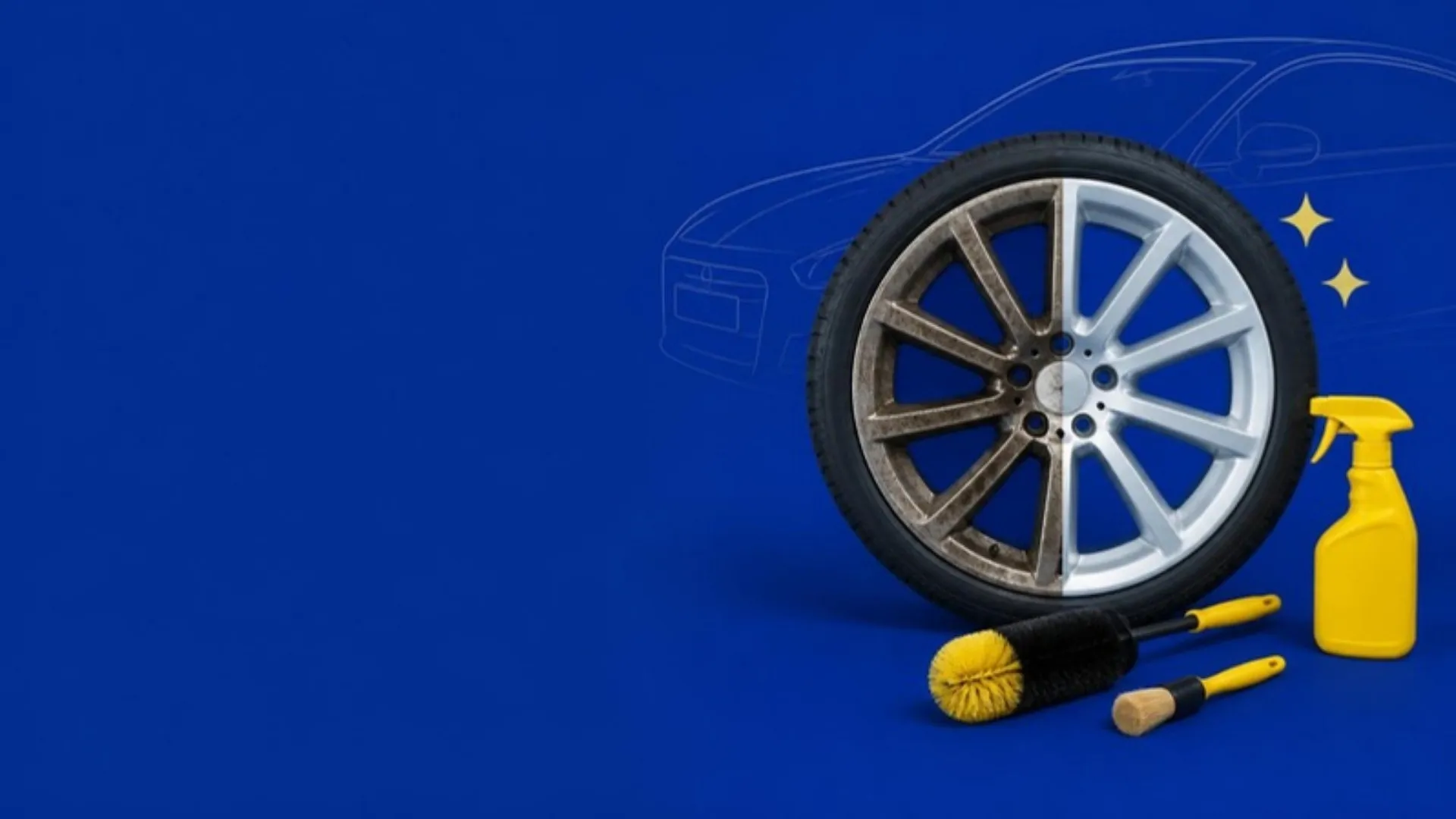
To clean brake dust off wheels, the most common method is a wheel cleaner, a few brushes and a pressure washer. Spray the cleaner on a cool wheel, brush the tire and the wheel face first, work your way to the inside of the wheel, then pressure wash everything off before the cleaner dries. If you are not a professional, we would go for an alkaline wheel cleaner.
What brake dust is and why it sticks
Brake dust is mostly iron. EBC Brakes, which makes brake pads, puts it at 92% iron in its own tests. The iron comes from the metal fibers in the pad and from the rotor as the pad wears it down.
EBC says the particles cling to the wheel by static, and under heavy braking they can bond to the wheel’s finish as hot sparks. That is the baked-on brake dust that does not rinse off, and it is why wheels get their own cleaner and their own brushes.
What you need to clean brake dust off wheels
- A pressure washer
- A wheel cleaner
- A wheel brush
- A tire brush
- A regular detailing brush. For this one we would recommend boar’s hair.
The tire brush is for the rubber. The regular brush is for the wheel face. The wheel brush is the one that reaches the inside of the wheel.
If your wheel cleaner is a concentrate, our chemical dilution calculator works out how much cleaner and water goes in the bottle.
Which wheel cleaner to use
A regular automotive wheel cleaner is what we would use. Wheel cleaners are sold as alkaline, pH neutral or acid. If you are not a professional, we would go for alkaline. For rims that are mostly clean, we would use a pH neutral cleaner.
The most common method among detailers is a pressure washer and a degreaser, and sometimes an acid cleaner if the finish of the wheel is right. Acid is the one we would leave to professionals, because the wrong finish can be damaged by it.
Whichever cleaner you choose, it is worth reading the label for the wheel finishes it is safe on before you spray it.
Which wheels need a gentler cleaner
Polished aluminum wheels, anodized wheels and custom finished rims are the ones to go gentler on.
Acid cleaner labels leave polished and anodized wheels out. PRO Super Wheel Brightener, an acid wheel cleaner, is sold for chrome, powder coated, clear coated and factory painted wheels. Its directions say not to use it on finishes such as magnesium, polished or anodized wheels.
A wheel care guide from the Wheel & Tire Council of SEMA, the car parts trade association, matches cleaners to finishes. For polished aluminum and for anodized wheels, it lists neutral pH cleaners. These are typically labeled “aluminum wheel cleaner”.
| Wheel finish | What it is | Cleaner |
|---|---|---|
| Clear coated, painted or powder coated | A coating similar to the paint on the body of the car | A regular wheel cleaner. Acid only if the label lists the finish. |
| Chrome | A shiny plated finish | A regular wheel cleaner. Acid only if the label lists the finish. |
| Polished aluminum | Bare aluminum with no paint or clear coat on it | pH neutral. No acid. |
| Anodized | Aluminum with a converted oxide finish, often in a color | pH neutral. No acid. |
| Custom finished | A finish that is not the factory one | pH neutral. No acid. |
If you are not sure which finish you have, the same guide suggests asking the wheel maker or the shop that sold the wheels. Some finishes look alike but are made very differently.
How to clean brake dust off wheels, step by step
- Check that the wheel is cool. If you have just finished driving, cool the rotor down first.
- Spray the wheel cleaner on the tire and the wheel.
- Clean the outside first. Brush the tire and the wheel face.
- Work your way to the inside of the wheel.
- Pressure wash the tire and the wheel. Always pressure wash.
Two things apply the whole way through. Do not let chemicals dry on the surface, and make sure the surface is not too hot. The SEMA guide gives the same advice: work on a cool wheel, in the shade if you can, and finish each wheel before the cleaner dries on it.
What to skip
- Acid, unless you are a professional. It is only for certain finishes, and the label decides which.
- Cleaning a hot wheel. Cool the wheel and the rotor down first.
- Letting the cleaner dry. Rinse before it does.
- Skipping the pressure washer. We would always pressure wash at the end.
How long a sealant lasts on wheels
A sealant or wax is the usual way to protect a wheel once it is clean. Sealants do not last as long on wheel faces as they do on paint, so it is worth expecting to reapply one sooner there.
Overall
Overall, how to clean brake dust off wheels comes down to a wheel cleaner, three brushes and a pressure washer. We would go for an alkaline wheel cleaner if you are not a professional, and a pH neutral one on rims that are mostly clean and on polished, anodized or custom finished rims. We would clean the tire and the wheel face first, then the inside of the wheel, and always pressure wash at the end. It is worth keeping the wheel cool and rinsing before any cleaner dries on it.